
READING TIME | 閱讀時間:
LANGUAGE(S) | 其他語言:
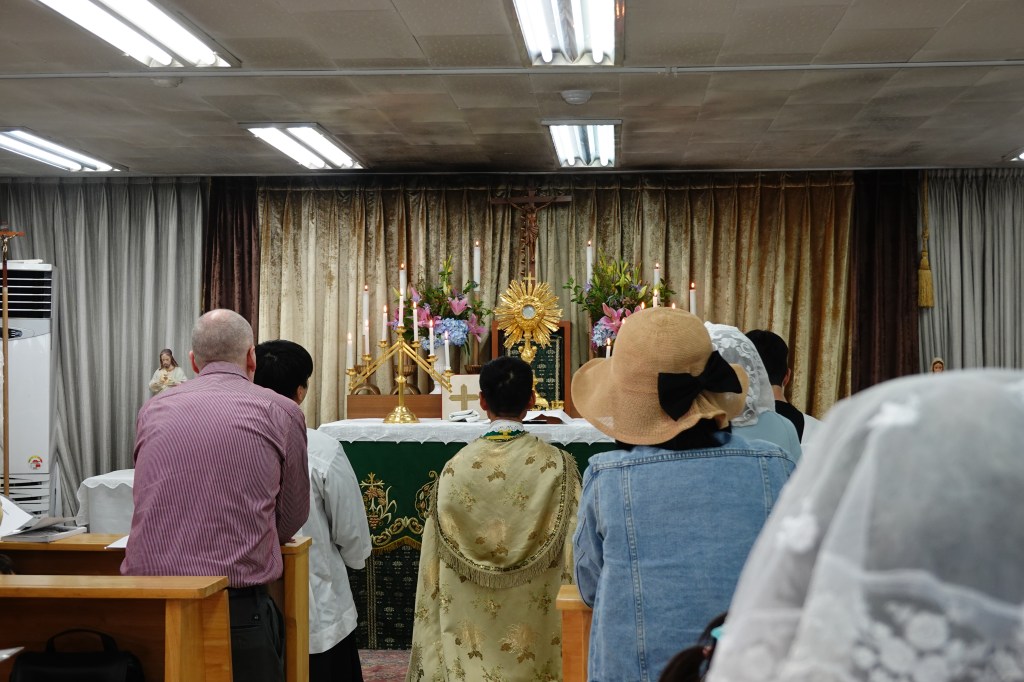
China has a population of 1.4 billions, and its Catholic population is estimated to be 6 to 12 millions, which means less than 1% of residents in China are members of the one Church of Christ. Still fewer people in China have realised the harm of Novus Ordo Missæ and other post-Vatican II reforms to one’s Faith, and are able to attend the Traditional Latin Mass (TLM) regularly, as there is only one parish in Shanghai in the entire country, celebrating the TLM occasionally. International Orders using the TLM (e.g. the Society of Saint Pius X or SSPX) are also unable to perform their work in China freely, due to the movement of the “Three Autonomies”. As much as the souls in China yearn for the true form of Catholicism aligned with God’s revelation through the Scripture, the Sacred Tradition and the Magisterium of the holy Church, China will remain to be a void of Traditional Catholicism, until more generous men and women are willing to dedicate their lives to the evangelisation of China.
This blog puts together a list of things you might want to obtain before leaving for China as a long-term missionary, speaking from the experience of a Catholic missionary who has been working in China for over 5 years. Although it is possible to purchase most necessary items, such as clothing (including both daily clothes and liturgical vestments), rosaries, sacred vessels and altar furnishings, from local sellers particularly those on Taobao, due to the strict restrictions imposed by Chinese government on immigration, importation and the access to the Internet, it is advisable to prepare the following beforehand.
1. Thorough Discernment
Coming to China as a long-term missionary is not a decision that can be made lightly. Apart from making sure that you yourself are solidly catechised, please discuss with your parish priest, spiritual director, or Religious superior about your interest in the Christianisation of China. Contact us, should you wish to learn more about the Church in Mainland China, and to explore your opportunities for studying Mandarin Chinese with us.
2. Chinese Visa
China does not have a type of visa for foreigners coming to China for Religious purposes, not mentioning most missionary activities are considered illegal or impermissible by the laws and regulations in China. We strongly advise you to conceal your intention to migrate into China as a Catholic missionary, before your entry into China, including during your visa application process. You might want to apply for a work visa instead. Check the website of Chinese Visa Application Service Center, or consult your local visa agent about how to apply for the appropriate visa that allows you to stay in China for long periods. Contact us to explore the possible assistance that we can provide you with, from Mainland China, for your visa application.
3. Vulgate and/or Douay–Rheims Bible
The Latin Vulgate Edition is the only version of the Holy Scripture that is declared by the Council of Trent to be undeniably authentic (Sess. IV). It is no doubt the “gold standard” of our interpretation of the Holy Bible. Depending on your ability to understand Latin language, you may want to bring a Douay–Rheims Bible instead of or together with the Vulgate, as the Douay–Rheims English Bible is a very close translation of the Latin Vulgate into a vernacular language. Although both versions are in the public domain and able to be read online for free, due to the increasingly tightened Internet censorship in China, it would be wise to bring the physical books with you while travelling to China. The two most popular Chinese Catholic Bible versions—the Studium Biblicum Version (思高聖經) and the Chinese Pastoral Bible (牧靈聖經)—can be easily purchased from many parishes or online stores in China.
4. Roman Catechism
Also known as the Catechism of the Council of Trent, the Roman Catechism is “a uniform and comprehensive manual”† of Catholic teachings, compiled in the wake of the Council of Trent. With little doubt, this should be a major source of what we teach as missionaries.
Find your Roman Catechism here.
5. Missal
There is no need to further stress the importance of the Holy Mass and the important role played by the missals for both the celebrant and attendees. For a lay missionary, due to the lack of the TLM in China, you may have to sanctify most Sundays here by following the Mass on your hand missal.
6. Breviary & Martyrology
These are the books used for the recitation of the Divine Office, which to the Holy Mass, is like the rays to the sun. There would be no rays without the sun. Conversely, the rays spread the glory of the sun and allow us to receive its light and heat. For lay missionaries in particular, reciting the Divine Office could be a permissible way to sanctify Sundays and holy days of obligation, if attending the Holy Mass is not an option.
Find your breviary and martyrology here.
7. Stable VPN
China uses mechanisms known collectively as “the Great Firewall (防火長城)” to block numerous useful websites, including but not limited to search engines like Google and DuckDuckGo, video platforms like YouTube, Twitch, Vimeo, and Rumble, social media and messaging services like Twitter, Facebook, Instagram, WhatsApp, Telegram, Signal, Gmail, and Yahoo Mail, as well as multiple news and encyclopaedia websites and useful online tools like ChatGPT. Some virtual private network or VPN services unblock and give us access to the aforementioned websites and online services. Because of such nature of VPN, most VPN services are blocked either partially or entirely by the Great Firewall as well, and it is generally impossible to purchase a VPN service while inside of Mainland China. It is therefore absolutely crucial to prepare a VPN service that can function stably in China before ever setting your foot on Chinese soil, in order to keep in contact with your Religious Order, family, and friends overseas as well as to listen to the sermons, podcasts, and audio books on those blocked platforms. Do your own research or contact us to find out the currently stable VPN services in China.
† Pope Pius V 1982, The Catechism of the Council of Trent: For parish priests, translated by J. A. McHugh & C. J. Callan, TAN Books, Gastonia, North Carolina, p. xxviii.

 Haus Jakob
Leave a Reply | 歡迎留言