
LANGUAGE(S) | 其他語言:
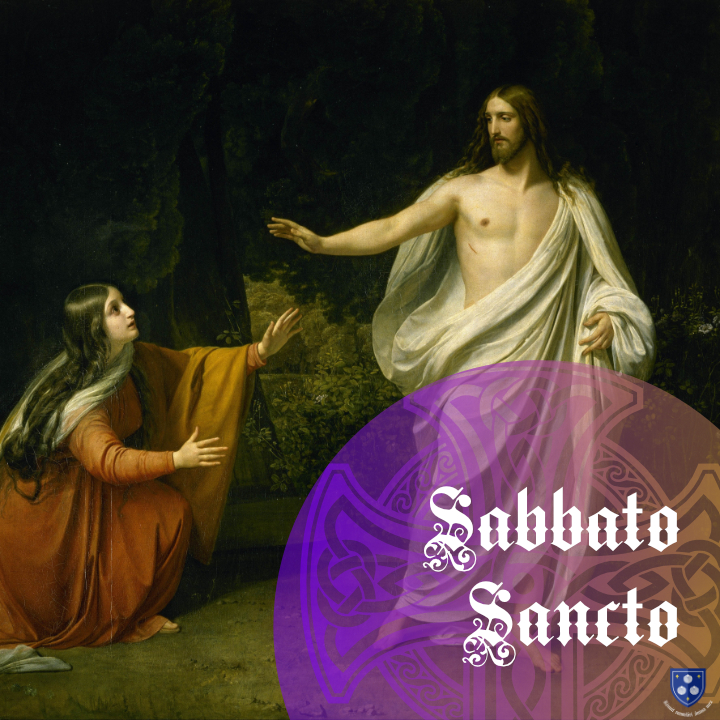
Holy Saturday is liturgically a day of deepest mourning, a day which the Church spends at our Lord’s sepulcher, meditating on His sacred passion and death. There is no Mass; the sacred altar is bare.
The Solemn Easter Vigil service, for which Pope Pius XII gave permission in 1951 and made obligatory in 1956, is intended to show liturgically how life and grace flow to us from the death of our Lord: the Light of the World is exhibited under the symbol of the Paschal Candle, dispelling the night of sin by the light of grace; the Exultet—the Easter Proclamation—is the song that heralds Easter, singing of the brightness of the holy night of Resurrection; the Lessons taken from the ancient prophecies tell of God’s wonderful dealings with His people under the Old Covenant, faint types of the glorious happenings that were to come to pass under the New; the waters for Baptism are blessed—those waters in which those who have been buried along with Christ die to sin and with Him rise to walk in newness of life; this grace He has won for us, and in Baptism bestowed on us; by renewal of our baptismal promises we publicly announce our purpose to show forth this newness in our daily lives—and finally the Church Triumphant is called on to intercede for us, and the Mass of the Resurrection begins.
The hour for beginning this solemn service should be selected so that the Mass of the Resurrection may begin about midnight; but the Bishop of the Diocese may judge it better for special reasons to begin earlier; nevertheless, this earlier start should preferably be later than twilight, and on no account before sunset.
SOURCE: Roman Catholic Daily Missal (1962) 2004, Angelus Press, Saint Marys, Kansas, p. 562.


 Haus Jakob